Nobody joins a multi-level marketing scheme thinking they are being scammed. They join because a friend they trust shows them a path to freedom. The pitch is warm. The community is welcoming. By the time the math stops working, the person has already restructured their identity around the dream. Leaving would mean admitting they were fooled. So they double down instead.
This same trap catches people in their politics. A person adopts a set of talking points and mistakes them for facts. The points get repeated by friendly voices until they feel like common sense. What actually happened is subtler and uglier. The person was gaslit with a blend of outright lies, convenient half-truths, and lies of omission. Nobody told them the whole story. They were handed a script and told it was reality.
Climate Change Denial as a Model
Climate change denial shows the pattern clearly. The denier does not weigh the evidence and then reach a conclusion. They decide in advance that climate change must be false, then work backward to defend that position. They collect talking points that sound intuitive. “The climate has always changed.” “It was cold last week.” These feel right. That is exactly the problem.
Science is not built to feel right. Climate science, like most science, is counterintuitive. That is why the scientific method exists. These are not facts a person can sit alone and intuit. They require many people working across overlapping fields, testing and observing over decades, combining their findings, and arriving at sound interpretations through peer review. You cannot armchair your way to atmospheric physics. The intuitive answer is often the wrong one.
The Dunning-Kruger Effect
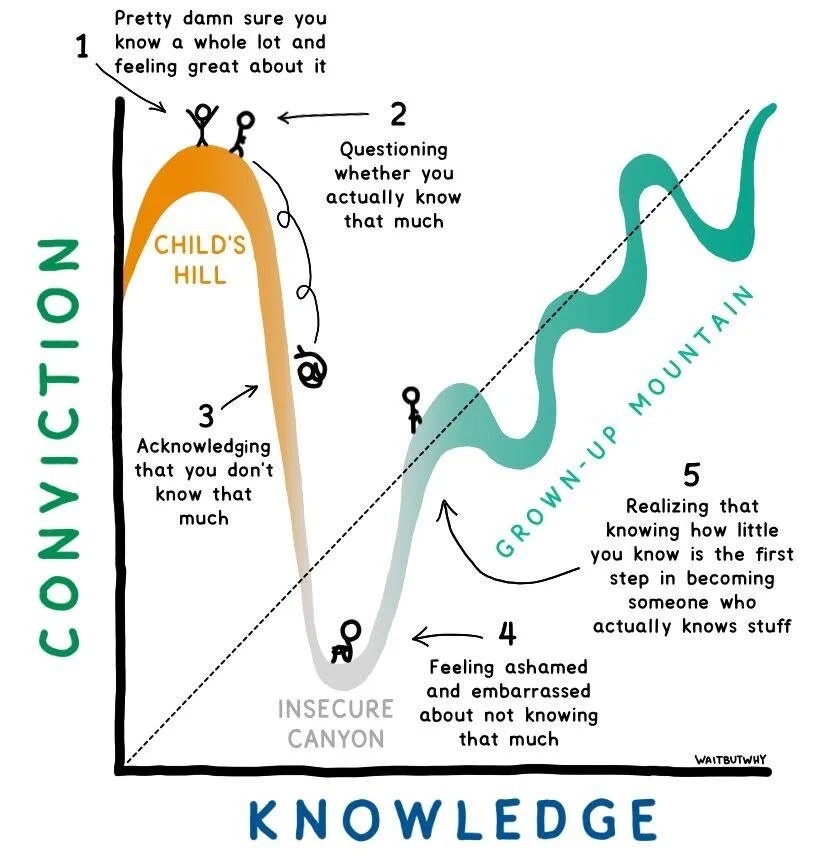
This is where the Dunning-Kruger effect enters. The idea is simple. People who know very little about a subject tend to wildly overestimate how much they understand. They lack the knowledge to recognize their own gaps. A little information feels like mastery. The genuine expert, by contrast, sees the full landscape of what remains uncertain and grows more cautious. So the loudest, most confident voice in the room is frequently the least informed. Competence and confidence often run in opposite directions. The MLM recruit who “did her own research” and the climate denier who watched one video share this exact blind spot. They do not know enough to know what they do not know.
Plato’s Cave
Plato gave us a model for this 2,400 years ago. Picture prisoners chained inside a cave, facing a blank wall. They have been there their whole lives. Behind them burns a fire. People walk past it carrying objects, and those objects cast shadows on the wall. The prisoners cannot turn around. The shadows are the only thing they have ever seen. So they name the shadows, study them, and call them reality.
Now imagine one prisoner breaks free and walks out into the sun. At first the light is blinding and painful. Slowly his eyes adjust. He sees real trees, real animals, the actual sun. He understands the shadows were just flickering imitations. Then he goes back to tell the others. Here is the cruel twist. They do not believe him. His eyes can no longer read the shadows well, so they think the outside world ruined him. They prefer their wall.
That is the echo chamber in ancient form. The shadows are the talking points. The cave is the community that feels like home. Leaving is uncomfortable and lonely. The people still chained will mock anyone who claims the wall is not the world.
Walking Out of the Cave
The exit always starts the same way. A single doubt. A number that does not add up. A question the script cannot answer. None of these traps survive honest curiosity, because they were never built on a foundation of truth in the first place. They were built on the feeling of truth, and feelings make a poor map. The hard part is not finding the door. The hard part is being willing to walk through it.